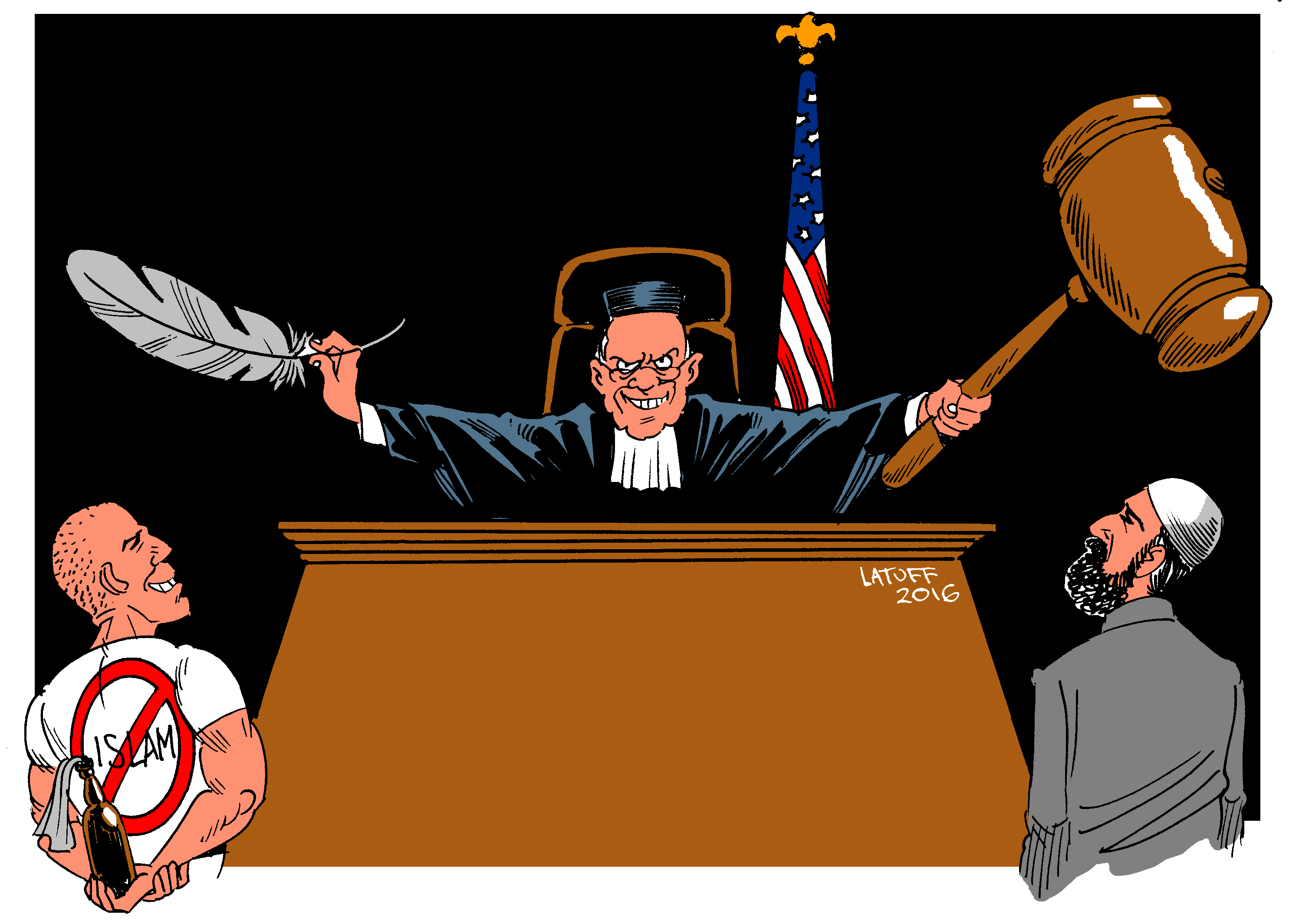
ASMA LAMRABET : LES FEMMES ET L’ISLAM : UNE VISION RÉFORMISTE.

Il est évident aujourd’hui que la thématique des femmes en islam reste tributaire d’une vision binaire très réductrice. Entre la vision islamique traditionaliste, qui refuse toute réforme par peur de perdre des valeurs identitaires idéalisées à outrance, et la vision dite « moderniste », qui inculpe le religieux et particulièrement l’islam de tous les maux, c’est d’abord et avant tout la voix de la grande majorité des femmes musulmanes que l’on marginalise.
Une véritable troisième voie prisée par une certaine dynamique de femmes musulmanes est déjà en marche aujourd’hui et privilégie, entre autres, des voies d’émancipation à partir d’une relecture féminine, voire féministe, et réformiste du référentiel musulman. Cette troisième voie réformiste est aujourd’hui, au sein des sociétés musulmanes mais aussi des communautés musulmanes en Occident, une des rares voies qui permettent de contribuer significativement à la dynamique de réconciliation entre islam, droits humains et défis d’une modernité mondialisée.


Curious George celebrates Ramadan for the first time

Via Middle East Eye

Growing up in Maryland, Hena Khan would scour her school and local libraries looking for books that reflected her personal experience. But her search always came up empty.

“Having grown up as an American-Muslim myself, I never saw books like that. I’d go to the library at school or the public library and I never found books that reflected me or my experience,” Khan, a Pakistani-American author, told Middle East Eye.

That is why when she was approached to pen the latest tale of Curious George, the curious brown monkey whose adventures have captivated children around the world for decades, she jumped at the opportunity.

“It was such a thrill and really to me, such an important step in the publishing industry towards inclusion and representing Muslims in a way that hadn’t been done before,” Khan said about being asked to write the book.

It’s Ramadan, Curious George was published in May and has already been making waves. The book tells the story of George visiting his friend, Kareem, who is fasting for the first time to mark the Islamic holy month of Ramadan. Khan has often spoken of how the timing of the book’s release, coming amidst a rise in Islamophobia in the US, is key.

‘Culture and spirit’ of Ramadan

In the book, George goes over to Kareem’s house to learn about Ramadan and what it is like to fast from sunrise to sunset. George distracts his friend when his stomach grows hungrily, and helps collect donations for charity at the local mosque.

The friends exchange gifts and break the fast together alongside Kareem’s family.

“It’s the first mainstream character, and a hugely loved character for so many decades, to celebrate and take part in a Muslim tradition,” Khan said.

Khan, who has penned two other children’s books about Islam, Night of the Moon: A Muslim Holiday Story and Golden Domes and Silver Lanterns: A Muslim Book of Colors, said she tried to keep the story from a child’s perspective and focus “on the culture and the spirit of the month,” rather than delving deeply into Ramadan’s religious significance.

She said she wanted the story to reflect the diversity of the Muslim community in the United States and maintain the sense of fun, curiosity and wonder that Curious George stories have become known for.

“I wanted to stay true to George’s spirit,” said Khan, like how George shares chocolate-dipped bananas with Kareem when he breaks his fast.

Meeting students at the Crescent Academy in Canton, Michigan (Courtesy of Hena Khan)

Sharing common bonds

Natalie Lovesey, a mother of two from London, Ontario, pre-ordered the book online and it arrived before Ramadan this year.

Lovesey told Middle East Eye she already owns a few books about Ramadan and Eid, but her three-year-old son, Ayoub, was especially excited to see a character he already knows and loves celebrating the holiday.

“He definitely knows Curious George as a character, watches the cartoon, has a George stuffed animal,” Lovesey said.

“It’s a character that I’m familiar with and he’s familiar with in a very mainstream way. I think it’s especially sort of helpful for him to see that mainstream character participating in his holidays, which he knows.”

Lovesey, who converted to Islam herself, said her husband, who grew up in a Muslim family in Canada, often comments on the increased awareness people have about Islam today compared to when he was growing up.

That’s thanks in part to having more examples of Muslim traditions displayed in mainstream popular culture.

“It can make kids feel less isolated,” Lovesey said. “They know that not everybody celebrates their holiday, but at least they feel like they’re not the only ones.”

Excerpt from the Curious George book (Courtesy of Houghton Mifflin Harcourt)

Khan agreed that seeing a mainstream character like Curious George sharing their holiday can make Muslim children feel validated and included, and help them build self-esteem.

She said she hoped the book would also show non-Muslims or those unfamiliar with Islam “that Muslims are very much like all other people”.

“We share more in common than they may realise and understand,” she said. “Having a character like George spend time with a Muslim family and share in Muslim traditions, and be respectful and curious, are all things that other people will learn from and be encouraged by.”

The book has sparked some controversy, especially on social media, where people have expressed concern that it could encourage children to try and fast too early.

The overwhelming majority of reviews, however, have been positive and the book has already attracted a host of non-Muslim fans.

“It’s [sic] a GREAT resource for introducing other religions to your children, because being opened [sic] minded is extremely important now more than ever,” a parent wrote in a recent  Amazon review of the book.

Another parent, Carolyn, wrote that it provided “a fun and cute introduction to the concepts of Ramadan and fasting” to her three young children.

“We are a mixed Christian/Jewish family. I am trying to raise the kids to understand the basic principals [sic] of and to respect other religions as well. Great little book,” she wrote on Amazon.

A growing market

Amina’s Voice, Khan’s latest book for children ages 8-12 wants to build on this message of inclusion and understanding further. It tells the story of a Pakistani-American Muslim girl struggling between fitting in at school and respecting her family’s culture.

The book will be released in March 2017 by Salaam Reads, billed as the first title from a major publisher (Simon & Schuster) that focuses on Muslim characters and stories.

Salaam Reads plans to publish nine books touching on Muslim issues for young readers every year to meet growing demand.

“There is an incredible range of cultural and religious traditions among Muslims in the United States and across the globe, illustrating that there is no one way to be Muslim,” said Zareen Jaffery, executive editor of Salaam Reads, about the new initiative.

“Our aim with the Salaam Reads imprint is in part to provide fun and compelling books for Muslim children, but we also intend for these books to be entertaining and enriching for a larger non-Muslim audience,” Jaffery said in a statement.

For Khan, Salaam Reads represents “another exciting step in the children’s publishing”.

And while she held high hopes that, It’s Ramadan, Curious George will be well received even after the holy month finishes, she said she never anticipated the outpouring of support it has garnered.

That reflects just how important these types of stories are, Khan said.

“I knew how much it would have meant to me when I was younger or even when my children were younger and how excited even my family was. I had a very good feeling about it going in, but I was just blown away by the response,” she said.

“People were expressing so much excitement and joy over it; they were really celebrating the fact that this book was coming out.”

The Decolonizing Struggle in France: An Interview with Houria Bouteldja

« We are the children of an illusion that consisted in believing that the independences of our countries signified the end of colonization. » — Interview with Houria Bouteldja, spokesperson of the decolonial movement in France known as the « Mouvement des Indigènes de la République » (MIR — Movement of the Indigenous of the Republic).1

Why do you assert yourselves as indigenous?2

Well, because we are living a neocolonial reality. We are the children of an illusion that consisted in believing that the independences of our countries signified the end of colonization. In reality, it was a matter of the first act of decolonization. We see it as much in the metropolis as in its relations with its former colonies: decolonization has yet to be finished. Its ideological and cultural bases still exist. We thus continue to live a different colonial phase. We, who experience diverse regimes and systems of oppression, recognize ourselves in this name because it demonstrates to all the oppressors, precisely and in a crude way, the reality of the state in which they want to confine us.

Why do you reject the notion of integration?

In effect, the abstract republic, so celebrated everywhere, refuses to recognize as citizens with full exercise of rights all those who have an origin in Africa or in the Arab-Muslim world. To integrate yourself, you have to deny the fundamentals of your culture and adopt what is the common representation of the ideal citizen according to the television or Alain Finkielkraut.3 But even then, it is not enough. Look at the history of the Harki4 and the discrimination they have faced in France since the end of the War of Algeria. It demonstrates the absurdity of this negation of one’s self, which, nonetheless, is proposed as the ideal option. At minimum, it seems we would have to resort to cosmetic surgery to try and get rid of our indelible differences. . .

How do they act against the MIR?

It is not easy to dispatch us by saying we are Islamists, terrorists, because we are also a movement of Africans, of Antilleans, of the French. . . . That’s why their attacks on us are indirect: constant defamation, the spectre of fear of marginalized suburbs,5 of Islam. . . . The ruling elites can no longer say openly that we are inferior, so instead they let it be understood in various ways. What appears to them as most efficient is to showcase « diverse » people who represent, for them, successful integration. The major sign of this success, of this dissolution into what they call « the French society » are people, above all women, who publicly manifest the abandonment of all references to their origins (it is what we call « integration via ham »6), or better yet, who adopt a very offensive posture against their community of origin. This posture, which translates, among other things, into the systematic stigmatization of the youth of the suburbs, is the one that results in the hegemonic political consensus. This is illustrated, for example, by the association « generously » supported by the state whose name perhaps your readers find shocking and I prefer not to mention.

You are referring to the association « Neither Sluts Nor Submissives. »5 The name of the group is notorious and is not going to shock anyone in Algeria. But, even so, these people equally stand up against a very real problem, that of the status of women and young girls in the marginalized suburbs. . . .

In all societies there exists a problem of masculine domination: the disadvantaged neighborhoods are not the only ones that have mistreated women. To designate the youth of the suburbs as a specifically violent category is a strategy aimed at confining us, Maghrebians and Blacks, in a representation that paints the foreigner, especially the Muslim foreigner, as retrograde and dangerous.

What is it that makes the « indigenous » a politically pertinent category?

The triptych of « colonialism, imperialism, superior ideological norms that should be imposed on all » continues to exist. It has been made fashionable again by the arrival of « neo-cons » to power in all of Europe. The word « indigenous » works as a painful reminder of this truth and our declaration of resistance to it, in terms of political thought, because it is a right slogan that challenges people. The word « indigenous » is a destroyer of myths: the myth of the universal and egalitarian republic. Moreover, it establishes the link with the status that our parents had in the colonial era and it teaches us that the struggle for liberation continues to this day here (in France) as it does there in the neo-colonial countries].

Why is this reality denied universally, from the right to the left?

Naturally, the centers of Western propaganda themselves feel they are being alluded to. These centers are of the left as well as of the right — the right that is always colonial and capitalist, the left that is ideologically dominating and paternalistic. Let’s remember the position of the SFIO and of the PCF8 during the War of Algeria. The left has not broken with its heritage. The historical mechanisms are still there, and, therefore, the use of the word indigenous is justified. Added to that is Zionism, which is today very powerful and which would have us believe that the truth is uttered only by the old propagandists of « new philosophy. »9 It is the unceasingly repeated thesis of the war against the politically un-submissive Muslims and their ex-colonial allies who are not effectively brainwashed, designated nowadays as « islamo-leftists. »

You are very much involved in the issues of international politics.

Yes, in the first place with respect to the Palestinian tragedy. In this drama, Westerners are making Palestinians bear the weight of their own demons. The negation of the Palestinian national fact is a crime. The genocide of Jews does not justify this denial of rights. The cause of these people is at the heart of our fight. We live in a world where representations are inverted: Israel is always painted the victim whereas it is a colonial state, violent and despoiling. One notices that the foreign policy of Westerners aims always to impose this state on the Arab peoples and on the international community. Look at the UPM(Union for the Mediterranean); the entire world clearly sees that it is a question of admitting the Israeli wolf in the Mediterranean sheepfold.

What are the « indigenous » doing and what are their prospects?

We are a political group that is not ideological, undivided by the false ethnic and religious conflicts, critical of the historical and sarkozyst republic, critical of the tendentious interpretation of secularism, etc. . . . The more we advance towards the assertion of ourselves, towards the possible formation of a political party, the more we become objects of criticism, particularly of the left that would like to recuperate us within a logic that considers that our struggle is in the end secondary compared to what they define as the principal questions that differentiate them from the right. In addition to underlying institutional racism, one of the principal obstacles is the Palestinian question and — one sees it clearly – the current political consensus on the Israeli ideas.

What is your relation to Algeria?

Emotional. It is my country of origin and I am very attached to my roots and our culture of resistance and solidarity. The libratory struggle of the Algerians belongs to my history. I have been interested in its political evolution over the last several years; I have observed with sadness what could happen there. Moreover, I am anxious about the role that the Maghreb states are playing in constituting the « gendarmes of Europe » against our brothers of Black Africa. They betray the spirit of independence and anti-imperialist struggle. But I have great confidence in the Algerian people. I am sure they will succeed in winning their rights, their liberty, and that they will know how to remain on the side of the oppressed.

ENTREVISTA CON ASMA LAMRABET

Desde hace no pocos años, existe una nueva corriente del feminismo, el llamado “islámico”, que reivindica la igualdad y la liberación de la mujer desde un prisma puramente musulmán, que no se rige necesariamente por los patrones clásicos del feminismo histórico. Una de sus representantes es la Doctora en medicina biologógica, autora de varios libros sobre la cuestión, Asma Lamrabet, natural de Marruecos. En esta conferencia impartida en español, Lamrabet deshace de forma clara y didáctica los tópicos más al uso.

Orientalism, Palestine and covering Islam By Hatem Baziam

This article first appeared on Anadolu Agency

OPINION: Orientalism, Palestine and covering Islam

Three of Edward Said’s books are as timely today as the day they were published almost 40 years ago: Orientalism (1978), The Question of Palestine (1979), and Covering Islam (1981). The three constitute Said’s trilogy that focused on literary and artistic representation in the service of empire, colonial dispossession, and the media shaping and reproducing Orientalist tropes. Said’s contributions are an invaluable source for anyone attempting to deconstruct the ebbs and flows of events and development in the Arab and Muslim worlds. At the same time, the three books offer a strong critique of Western policies and public discourse that purport to cover the “East” as a separate and mysterious place filled with irrationality.

Observing the daily events in the Arab and Muslim worlds, one is at a loss to comprehend the sheer destruction and the snuffing out of hope faced by a multitude of peoples – 1.4 billion, to be precise. Said’s writing intuitively de-constructed the racialized lens used by Western academics, press, and policymakers to justify their continued disregard of the needs and well-being of the Arab and Muslim worlds.

Critically, Said’s work reframed and provided a more in-depth history to the ongoing conflicts in the region, including a centering of the role played by colonialism in shaping the region. The currently unfolding events provide an appropriate time to bring Said’s views into play to possibly understand the current deepening crisis in the Arab and Muslim worlds. What would be a Saidian response and commentary on the contemporary unfolding events, and what lines of analysis should be pursued? It is important to recall that Said’s Orientalism, Covering Islam and The Question of Palestine emerged around and in the aftermath of the 1973 Arab-Israeli War, the Lebanese Civil War, and the Iranian Revolution.

At the time, Western academics and press reports focused on the now, just like the crop of contemporary Orientalist practitioners that cover the unfolding events and the disintegration of Afghanistan, Syria, Iraq, Libya, and Yemen without examining the long road that led to the current conflicts at hand. They are writing and reporting on the subject matter as if they are dealing with a lab and operating clinically to describe the small and big movements without ever asking how, why, and what are the internal and external stimuli that cause the particular movements.

What would Said say about the ongoing carnage, both the physical and, more importantly, the mental disfiguration masquerading as sound academic research and intellectual pursuit? Despite the passage of almost 40 years since Said’s monumental works and hundreds, if not thousands, of papers, articles, editorials, conferences, and special reports about what we broadly call the Arab and Muslim worlds, the political elite has learned and applied less of what supposedly was studied.

The trilogy of misrepresentation is found among media talking heads, empire’s embedded academics, and political elites who daily unleash a barrage of obfuscation and distortions and sensationalize the Arab and Muslim worlds. Current movies, books, and public discourses have repackaged every Orientalist trope and distortion into a new Islamophobic and racist entertainment industry that feasts on a heavy dose of the racialized Arab and Muslim figure as the all-encompassing evil villain threatening life itself.

Existing and newly formed academic fields with a plethora of embedded intellectuals have helped refine and produce the new crop of Orientalists who are committed to documenting the Arab and Muslim subject as best he/she can never imagine and then offer a manifest destiny to bring civilizations to the purported subhuman. Said’s focus on the role of the intellectual is pertinent today since embedded academics are feasting on empire’s trough filled with grants and projects intended to study the exotic Arab and Muslim subject so as to understand its proclivity to resist. Indeed, the role of the intellectual has been eroded due to the encroachment of power, capitalism, and the narrowly constructed interests that pass for academia today, which is a form of refined sophistry and preoccupation with access to power circles and upward mobility.

The Orientalist imaginary still captures the minds of many a dreamer of grandeur in the West, and a campaign afoot to discover, document, and civilize the East for its sub-humanness necessitates the never-ending intervention. Said’s Orientalist of the past has produced an emboldened crop that utilizes an ideological and material “shock and awe” epistemic to civilize the “barbarians” at the gates of civilizations. The grotesquely crafted binary at the root of the clash of civilizations has found a new and emboldened lease on life, and a cadre of well-polished salesmen and women have taken to the airwaves to frame, rally, and poison public sentiments. Said wrote about the clash of ignorance in response to Bernard Lewis’ and Samuel Huntington’s initial thesis, but today their ideas are driving elite policies and infecting public sentiments. U.S. presidential candidate Donald Trump’s rhetoric is the crude version of the sophisticated dons of academia and the think-tank industrial Orientalist complex that regurgitates the same distortions from the distant past.

A volatile Orientalist toxic mix is seamlessly wedded into deep and unrestrained hostility and otherization directed at everything and anything related to Islam or Muslims. In addition, Palestinians and Palestine are treated with vitriolic animosity coupled with a total disregard for their lives and well-being that brings Said’s trilogy to focus like no other place. Astonishingly, a U.S. president supported by European coalition partners and Arab despots invaded Iraq, causing millions of deaths and destruction beyond imagination, but the Muslim subject is posited as the violent one needing to explain his/her propensity toward violence. Palestinians in Gaza are bombed by Israel into oblivion with the wanton targeting of civilians and infrastructure, but the world is silent, and Benjamin Netanyahu is welcomed with the red carpet!

More critically, who should be held responsible for the ongoing chaos and the emergence of Daesh after the collapse of a sovereign state, Iraq? Who should be responsible for the ongoing siege on Gaza? If democracy is the desired and ideal political system championed by Orientalists, Zionists, and the embedded intellectuals, then why oppose it in Egypt and Tunisia, and aid those in the region that are intent on disrupting the march toward freedom, dignity, and justice?

Said would feel the torment for what has befallen Palestine and the destruction thrust upon the Palestinians in Gaza and the West Bank. He would denounce the utter impotence of the Palestinian Authority and fight to not forget the security coordination to protect the illegal settlers and settlements. Palestine’s circumstances directly emerge from the Orientalist machinations and the never-ending specter of the Sykes-Picot Agreement that carved the Ottoman Empire into the existing figment of independent states ruled by sorry excuses for leadership. The colonially nurtured Arab and Muslim ruling elites are still suckling on the metaphorical colonial bosoms and administering punishment to their own populations and fomenting wars against neighboring states so as to keep the global military-industrial machine humming at their expense. Said would lament the cowardice of the intellectuals, the vanity of the political elites, and the arrogance of the powerful who set the world ablaze in pursuit of wealth and total domination.

La industria de la islamofobia y el racismo institucional

Via WebIslam

La islamofobia se ha convertido en una enorme industria de producir miedo y terror, poniendo sobre la mesa asesinatos, atentados y víctimas inocentes. Los instrumentos de la islamofobia industrial moderna son principalmente:

a) Los medios de comunicación tradicionales. Las grandes cadenas o corporaciones, (Mass Media), no son neutrales, y actúan  según el interés de sus propietarios, calificando a los terroristas como radicales, yihadistas o islamistas, cuando en realidad, no forman parte del islam, y por sus crímenes se han convertido en herejes, que se han salido del islam. El ciudadano normal sufre un bombardeo informativo diario con titulares sensacionalistas en radio, prensa y televisión, que no pueden dejar de influirle en su forma diaria de ver el islam y a los musulmanes.

b) La difusión por internet, a través de páginas de facebook, youtube, blog, twitter y web, donde se describe al musulmán como un peligro y al islam como una ideología intolerante, cuando en realidad el islam no es una ideología, sino una religión de paz, que somete la guerra a una duras disciplinas de respeto a los civiles y prohíbe el suicidio. Los islamófobos se sirven de videos de atentados terroristas y declaraciones de clérigos extremistas para atacar al islam. Estos clérigos desviados ofrecen una imagen deformada del islam, fruto de su ignorancia y su vasallaje a intereses ajenos al islam.

c) La construcción de una seudo-intelectualidad, representada por escritores, directores de cine actores, actores y pensadores ilustrados con escasos escrúpulos y deficiencia en su formación académica, que en busca de la fama, la gloria o simplemente el dinero, se arrastran a la nauseabunda charca de la islamofobia para beber de sus apestosas aguas, creando libros, películas y artículos y ensayos, que denigran a la comunidad musulmana y la estigmatizan frente al resto de la población. Un ejemplo de esto es el artículo de Sánchez Dragó, “Moros en la costa”, en el que literalmente dice, “el Islam persigue como postrer objetivo el de convertir a todos los seres humanos, degollar a quienes no se avengan a ello y crucificar a los apóstatas”.

d) La creación de asociaciones abiertamente islamófobas, financiadas por intereses privados o subvenciones públicas, que no dejan de atacar el islam, mediante acusaciones infundadas contra el Sagrado Corán y la Sharia, que generan prejuicios y malos entendidos. Asociaciones que combaten el uso del velo islámico, la comidahalal, o cualquier otro elemento islámico.

La islamofobia, no está situada en un sector concreto de la población, sino que actúa como un cáncer, que ha desarrollado una metástasis que invade toda la sociedad:

a) Islamofobia Social:

— seudo-religiosa, por parte de grupos nacional-católicos o de la extrema derecha evangélica, que consideran que en occidente no hay cabida para el islam, algo que es falso, ya que por ejemplo, la sociedad española tiene una importe influencia del islam en su configuración, Bosnia y Albania son sociedades mayoritariamente musulmanas.

Lamentable ejemplo de esta islamofobia religiosa son las declaraciones de Tenzin Gyatso, Dalai Lama y líder espiritual del budismo tibetano, que manifestó que“Alemania, no puede convertirse en un país árabe”, pero que guarda silencio sobre los crímenes y el genocidio que sufre la minoría musulmana rohinyás, en Birmania a manos de budistas fanáticos. Una doble vara para medir las cosas.

— Seudo-feminista, que no reconoce el derecho de las mujeres musulmanas a ser ellas mismas, y que quiere imponerlas su visión sesgada del modelo de mujer occidental, lo que no deja de ser un neo-colonialismo de la mujer musulmana.

— Islamofobia seudo-laicista, que en nombre de una neutralidad religiosa de la administración y los establecimientos públicos, sus objetivos son que no se ofrezcan menús halal en los colegios y se prohíba el uso del velo o hiyab en los edificios públicos, lo que implicaría que muchos niños se alimentes de productos prohibidos por el islam o las mujeres no puedas ser funcionarias si usan hiyab. Tampoco podrán ser concejales, si usan hiyab, ya que no podrían acudir a los plenos municipales, ni podrían asistir como alumnas a colegios, si llevan algún signo identificativo musulmán.

b) Islamofobia Política:

— La creación y fomento de partidos xenófobos de corte populista, (que a veces infectan a los partidos conservadores), y que de manera reiterada, en nombre de los derechos humanos, criminalizan al islam, señalándolo como incompatible con la democracia y los derechos humanos, para a continuación pedir el cese de la inmigración de origen musulmán o la expulsión de los que ya se encuentran en países occidentales.

— Los grupúsculos ultras, de una ideología identitaria, que identifican al islam y a los inmigrantes musulmanes como invasores y destructores de su cultura,  haciéndoles responsables del paro, la delincuencia o la inseguridad ciudadana. Describiéndolos como vagos que viven de las ayudas sociales y se dedican a tener hijos en masa. Javier Maroto, ex alcalde del PP, acusó a los trabajadores extranjeros de “abusar” de las ayudas sociales, provocando una escalada de actos xenófobos sin precedentes en Vitoria.

— Los partidos tradicionales, que dan cobertura desde posiciones presuntamente de izquierdas o liberales al discurso seudo-feminista y seudo-laicista.

c) Islamofobia económica:

— Los recortes sociales y la falta de una política de redistribución de la riqueza por parte de las instituciones del Estado han provocado que la pobreza crezca a niveles desconocidos en Europa desde la segunda guerra mundial y la guerra civil española. El 15% de los trabajadores de España son pobres y, desde 2012, la cifra de hogares que no percibe ningún ingreso no ha bajado de 700.000. Esto supone que la población musulmana, (un 51% es inmigrante), viva en unas condiciones económicas severas, en los barrios más deteriorados por el abandono institucional, donde se unen miseria y marginación con musulmán.

— La falta de recursos económicos deja a la población musulmana lastrada en el último escalón de la pirámide social, con menos oportunidades de desarrollarse y formarse, lo que hace que sufra un racismo económico.

Todo este engranaje solo puede mantenerse porque existe un “racismo institucional que lo tolera” y una legislación deficiente y difícil de aplicar contra estos grupos y organizaciones y personas islamofobas que actúan con gran impunidad. No existe en España ningún mecanismo fiable que contabilice los casos de islamofobia o xenofobia  que se producen, lo que le permite al Estado decir que no existe la islamofobia en España o que esta es residual, pero se desconoce:

a) El número de personas que han sido despedidas de su trabajo por ser musulmanes en un momento de crisis como el que se vive.

b) El numero de musulmanes que han tenido problemas para alquilar viviendas por sus creencias.

c) El número de mujeres que no han sido contratadas por usar hiyab o de hombres musulmanes que no fueron contratados por sus creencias.

d) El numero de musulmanes que han sido agredidos verbalmente por sus creencias o han sido discriminados en su vida normal.

e) El número de casos de musulmanes discriminación por parte de la administración pública.

f) El número de niños musulmanes que carecen de clases de religión o menús halal en sus colegios.

g) El número de agresiones físicas sufridas por ser musulmán, ya que la inmensa mayoría no se denuncia por desconfianza en las instituciones públicas o por miedo a denunciar por carecer de permiso de residencia.

La nula voluntad del Estado en contabilizar los casos de islamofobia y en el incumplimiento de los acuerdos de cooperación entre el Estado español y la Comisión Islámica de España, aprobados en 1.992, mediante la Ley 26/92, en 1.992, es suficiente muestra para poder afirmar que la islamofobia esta institucionalizada en España por el propio Estado, ya sea por omisión de sus funciones o carencia de medios.

La islamofobia institucional ha permitido que una parte importante de la población tenga desconfianza y miedo hacia el islam y poder justificar las ventas de armas, las guerras y el saqueo de la riqueza de los países de oriente medio. Hashim Cabrera, director de Webislam, señaló en cierta ocasión, “que antes se creaban armas para las guerra, y ahora se crean guerras para vender armas”.

El terrorismo alimenta la industria de la islamofobia y ésta justifica la marginación y discriminación de la población musulmana, que se ve abandonada por las instituciones que debían cuidar de ella. La islamofobia institucional está beneficiando a los vendedores de armas y a los compradores del petróleo controlado por los terroristas en el mercado negro, mientras miles de personas se quedan si familia, sin brazos o piernas, sin amigos, sin sus casas, sin su trabajo y sin futuro. La imagen de un niño muerto en el Mar Egeo no ha enternecido el duro corazón de los traficantes.

FARID ESACK

Durante los años 80 Farid Esack se convirtió en en una de las principales voces dentro del Islam en contra del apartheid que sufría su país Sudáfrica. Sus discursos y sermones que fueron ampliamente distribuidos encontraron una calurosa acogida en ambientes anti-racistas, principalmente cristianos. Por su parte, dentro de la comunidad islámica de Sudáfrica, Esack continuaba siendo una figura controvertida.
Farid Esack propuso una revolución metodológica dentro del Islam. Propone un nuevo tafsir, una nueva exégesis coránica y el desarrollo de una nueva hermenéutica. Parte de la visión de que el texto es fluido, abierto y con múltiples interpretaciones. Propone un lectura contextualizada del Corán y al mismo tiempo tener claro que ninguna interpretación es completa o final. Diferentes lectores/creyentes en diferentes contextos traen diferentes preguntas e interpretaciones.
Para él, así como para otros/as integrantes de la Teología Islámica de Liberación los valores éticos son el horizonte hacia el que hay que encaminarse. El Texto sagrado se lee desde una visión de los pobres, marginados, subalternizados y aquellos en los márgenes. De ahí sigue la visión del Corán como inclusivo con otras tradiciones religiosas, con otras interpretaciones. La fe en Allah está unida la justicia social.

AHORA PUEDES VISITAR LA BIBLIOTECA MAS ANTIGUA DEL MUNDO EN FEZ

al-qarawiyyinlibrary

La biblioteca mas antigua del mundo reabre sus puertas. al-Qarawiyyin, en Fez, construida en 859 es la biblioteca mas antigua del mundo. Punto de referencia para poetas, académicos y teólogos durante 100 años. En los últimos años había caído en un estado de descuido lamentable, pero después de un esfuerzo de reconstrucción durante los últimos 3 años se ha conseguido su reapertura.


The center includes the large library, as well as a mosque and a university that may be the oldest degree-granting institution in the world. It was founded by Fatima El-Fihriya, a rich merchant’s daughter who dedicated her inheritance to building the center (a habit that ran in her family, as her sister, Maryam, was the sponsor of Fez’s Al-Andalus mosque). After the Moroccan Ministry of Culture received a grant from Kuwait’s Arab Bank, they chose Canadian-Moroccan architect Aziza Chaouni, who grew up in Fez, to head the project. Since 2012 she and her team have corrected structural damage and painstakingly updated mosaics to preserved the library’s original beauty, while also modernizing the space with an airy cafe, courtyard umbrellas and misting stations, and a museum highlighting al-Qarawiyyin’s history.

As the center expanded in the 10th and 11th centuries, new facilities were added on that ranged over several levels of surrounding hills, so one of the difficulties of Chaouni’s job was to get each individual space up to the same standard of insulation and wiring. In addition to that, she needed to restore centuries-old wooden beams, and the delicate mosaic tiles called zellige, and faced the additional challenge that comes with an ancient building, like say when you break through a wall and find a centuries-old sewage system.

al-Qarawiyyin Mosaic

Chaouni, a TED fellow, talked to their Ideas blog about the restoration:

While working hard to protect and preserve, Chaouni had to bring a sense of 21st-century pragmatism to the project. “I didn’t want the building to become an embalmed cadaver!” she says. “There has to be a fine balance between keeping the original spaces, addressing the needs of current users, including students, researchers and visitors, and integrating new sustainable technologies — solar panels, water collection for garden irrigation, and so on.” Another thing that needed updating: the library’s fountains. Embedded within the dense urban fabric of the UNESCO World Heritage Medina of Fez, fountains are part of the city’s vast and ancient water network. Chaouni took special care to restore the library’s original courtyard fountains, but where necessary, she created them from scratch, using local materials and construction systems, and introducing passive energy.

Another challenge was restoring the books themselves, as NPR relates. al-Qarawiyyin houses texts including a 9th-century Quran written in Kufic calligraphy, the original copy of Ibn Khaldun’s 14th Century Muqadimmah, a manuscript on Islamic jurisprudence by Ibn Rochd (known as Averroesin Europe), and the oldest known collection of Islamic hadith, which are early accounts of the life and words of the Prophet Muhammed.

al-Qarawiyyin Reading Room

The al-Qarawiyyin Library opened to visitors last month, so those of you who are Morocco-bound, be sure to check it out! And for the rest of us, you can learn more about the project here and here, and see more images of al-Qarawayyin’s beautiful mosaics here.

MÚSICA DE MARRUECOS: PAUL BOWLES Y LA MÚSICA MARROQUÍ

Music Of Morocco features recordings of classical Moroccan musicians.

El escritor Paul Bowles fue por primera vez a Marruecos en 1931. Fue un amor a primera vista. EN los siguientes años visitó el país varias veces hasta que finalmente decidió instalarse en Tánger donde vivió hasta su muerte en 1999. Bowles admiraba muchas cosas de la cultura marroquí y entre ellas la música ocupaba un lugar principal.
Durante 5 intensos meses en 1959 Paul Bowles recorrió el país realizando grabaciones de música para la Biblioteca del Congreso en Estados Unidos. Ahora esas grabaciones ven la luz con el nombre “Musica de Marruecos”.
Para realizar las grabaciones, Bowles recorrió el páis subido en su Volkswagen Beetle con una grabadora. Por ejemplo en la ciudad de Fez grabó a una orquesta andalusí, en cuyas canciones se pueden ver las influencias de la España morisca.


Conversos sufíes, los místicos del Islam

Via Islam Hoy

Órgiva es la pequeña Manhattan de Andalucía. Capital de la Alpujarra granadina, lugar de retiro del último rey nazarí Boabdil, tierra de moriscos y cuna de heterodoxos, prolonga en el presente una parte del esplendor multicultural del pasado, pues esta localidad de apenas 6.000 habitantes alberga en su callejero 68 nacionalidades distintas.

Quizá la mejor encarnación de este variopinto mestizaje sea el café Baraka, regentado por Qasim, un bilbaíno de 41 años y musulmán converso. En este local, símbolo de la tranquila Babel de Órgiva, conviven el lugareño feliz y jubilado de todo, el filósofo errante, el profeta laico con su desierto a cuestas, el hippy que descubre en un té moruno una nostalgia perdida en Woodstock.

“Aquí a nadie se le niega la entrada”, resume Qasim (Pedro Barrio antes de su conversión). Pero el café Baraka –donde no se sirve alcohol– es, sobre todo, el sancta sanctórum de la comunidad musulmana. Se trata de conversos españoles que no solo decidieron abrazar el islam, sino que ahondaron en su rama espiritual y mística, el sufismo. Una vida de contemplación y de paz.

“Cuando le dije a mi familia que me iba a hacer musulmán, mi madre lo aceptó”, recuerda Qasim. “Pero mi padre se disgustó mucho. En el islam, el cerdo y el alcohol están prohibidos. Daba la casualidad de que en Bilbao yo era catador de vinos y teníamos además un restaurante familiar, al que todo el mundo conocía por el bar de los jamones. ¿Cómo iba a hacerme musulmán y estar a la vez bebiendo vino y cortando jamón? Así que me desvinculé del negocio familiar y monté el mío propio. Hace 11 años que soy sufí. Y es una de las mejores cosas que me han sucedido en la vida”.

El islam, aseguran los conversos españoles, les ha aportado “esperanza y seguridad”. Pero no ha sido fácil. Salvo contadas excepciones, todos ellos se enfrentaron a la incomprensión de sus allegados. Tuvieron que explicarles que el islam nada tiene que ver con los salafistas y yihadistas, apegados a la violencia y a la interpretación literal de los textos sagrados.

De hecho, hasta hace unos años los sufíes conversos han estado sometidos a la vigilancia de los servicios secretos del Centro Nacional de Inteligencia (CNI). “Nos citaron en un lugar cuyo nombre no puedo decir y nos preguntaron quiénes éramos, qué hacíamos, qué relación teníamos con grupos islamistas”, relata Omar Ibrahim (antes Rafael Martín), un madrileño de 59 años. “Después de un tiempo, al comprender que solo cantábamos y rezábamos, nos dejaron en paz. Pero algunos seguimos teniendo pinchados los teléfonos”.

Un gran número de sufíes españoles pertenecen a la orden naqshbandi, que se remonta a los tiempos de Abu Bakr as-Siddiq, el compañero predilecto de Mahoma y su sucesor en el califato. El emir en España es Umar (antes Felipe Margarit). Lo nombró a mediados de los años setenta el maestro general, el jeque Nazim, quien falleció en Chipre la pasada primavera.

La orden, explica Umar, barcelonés de 63 años, es un cruce entre un centro espiritual y un hospital. “Nazim acogía a todos los heridos por la sociedad actual. Él mismo se consideraba un cero. Decía que solo tenía algún valor si Dios, el Uno, lo colocaba a su derecha. Su hijo y ­sucesor en la jefatura naqshbandi insiste en lo mismo”.

Estos íntimos de Allah prefieren desempeñar alguno de los cuatro oficios prestigiados por su tradición: la agricultura, la ganadería, el comercio y la artesanía. Lo que no significa que constituyan una comunidad hermética al margen de la sociedad, como los amish, por ejemplo

En toda España hay unos 1.200 sufíes ­naqshbandíes. La comunidad más amplia, 35 familias, está en Órgiva. Esto se debe a que precisamente ahí vivía Umar antes de convertirse al islam. Una vez que fue proclamado emir por el sheij Nazim, todos los musulmanes españoles sufíes que pudieron se agruparon en torno al líder catalán en dicha localidad granadina. La segunda comunidad sufí en importancia vive en Villanueva de la Vera, en Cáceres. El campo es más propicio para el desarrollo espiritual y la contemplación de Alá.

Bajo la luz inverniza, un grupo de sufíes varea los olivos en las montañas orgiveñas. Estos íntimos de Alá prefieren desempeñar alguno de los cuatro oficios prestigiados por su tradición: la agricultura, la ganadería, el comercio y la artesanía. Lo que no significa que constituyan una comunidad hermética al margen de la sociedad, como los amish, por ejemplo.

No desprecian Internet, ni la televisión, ni los periódicos. Sus hijos asisten a los colegios de la localidad. Pero todos ellos coinciden en una vida espartana y justifican con su actitud la etimología del término sufismo, que deriva de la palabra árabe suf (lana) y que en sus orígenes se aplicó a ciertos ascetas musulmanes que, imitando a los eremitas cristianos, se vestían con esta ropa humilde en señal de renuncia a las vanidades mundanas.

Porque el sufí vive en el mundo sin ser del todo de este mundo. “Todos los días le pido a Alá que me ayude a convertir mi ego en mi alfombra de rezo”, confiesa Mansur (José Carlos Sánchez), un malagueño de 41 años licenciado en Psicología que denuncia que, “a pesar de que la cultura de Al Ándalus está de moda, existe un innegable rechazo al musulmán”. Su mujer, Bahía (María José Villa), una sevillana de 35 años licenciada en Derecho, asiente: “A los conversos nos miran como a bichos raros. El islam no es lo que la gente cree. El islam es paz. Es pedir amor a Dios no para quedarte tú con él, sino para devolverlo a los demás. Si tu intención en la vida no es derretirte en el amor puro, que es Dios, tu islam no tiene ningún sentido”.

“Y eso es lo que no toleran ciertos círculos próximos al integrismo islámico, que pretenden derogar la aleya de la misericordia del Corán por la de la espada”, dirá Muhammad Iskander (Alejandro), un gijonés de 54 años que prefiere ocultar su apellido y que ha trabajado de patrullero del servicio de vigilancia aduanera, de tatuador y de marino mercante, “aunque el único oficio constante que he tenido en mi vida ha sido buscar a Dios”.

La dergha –la casa de reunión y oración sufí– está separada de Órgiva por unos tres kilómetros de caminos tortuosos que jadean en medio de olivos y naranjos, de huertas feraces y del agua conventual de las acequias. En la dergha, la comunidad sufí celebra el jueves, a la caída de la tarde, el dhikr o recitación de los nombres de Alá, una práctica común a otros musulmanes, y el hadra, un ejercicio de meditación exclusivamente sufí consistente en entonar una serie de cánticos en alabanza a Dios acompañados de balanceos rítmicos de brazos y cuerpo, y todo ello escoltado por el sonido de instrumentos de percusión en la penumbra de las velas. “Esta práctica recuerda el momento en que Dios insufla con su aliento vida a Adán”, cuenta Amin (Andrés Fernández).

“El viernes, día sagrado en el islam, celebramos también la oración del yuma y después una comida comunitaria. Todas las oraciones las hacemos en árabe. Y ahí se reduce el conocimiento que tenemos, salvo excepciones, de la lengua sagrada. Nuestra formación islámica proviene de muchas lecturas, de conversaciones con otros hermanos más sabios y del sermón del sheij. Los naqshbandi somos tal vez los menos intelectuales de los sufíes. Nos interesa más el corazón”.

Amin es un leonés de 45 años, casado, que llegó a profesar las órdenes menores en el seminario. “Pero murió mi padre, tuve una crisis espiritual muy fuerte y me hice comunista. No quería saber nada de Dios”. Amin se queda pensativo unos instantes; luego concluye: “Cuando me convertí al islam, sentí que por fin regresaba a casa”. “Mi maestro me enseñó el arte del fracaso. Es decir, aprender a fluir con la vida y a pensar con el corazón”, explica Amin. “El que obra así no llegará nunca a nada en la sociedad actual. Pero se habrá ganado a sí mismo, porque para él tendrán el mismo valor el oro y el barro. Eso es ser sufí”.
orgiva
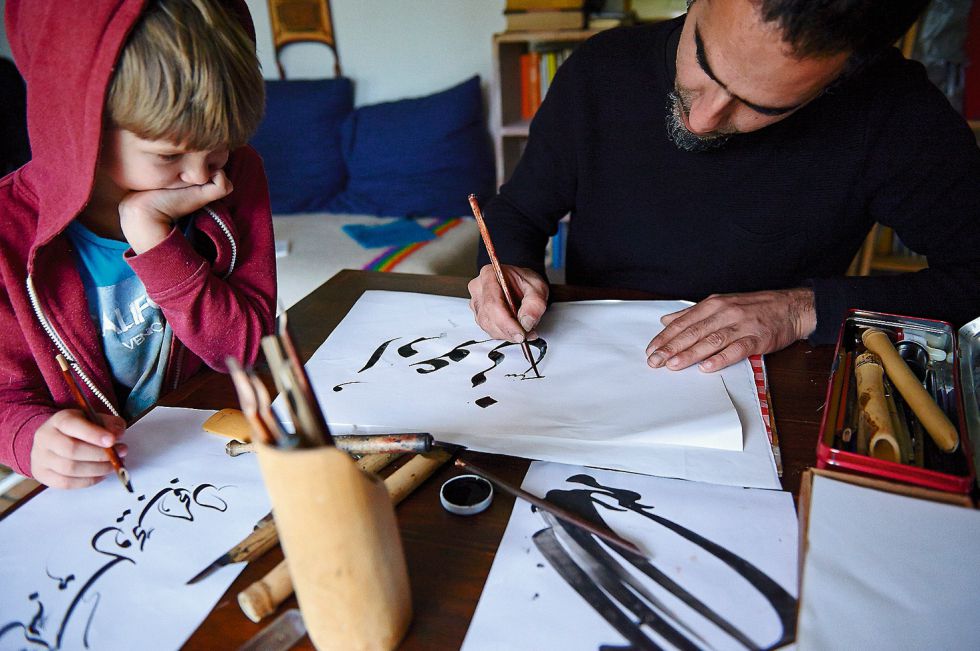
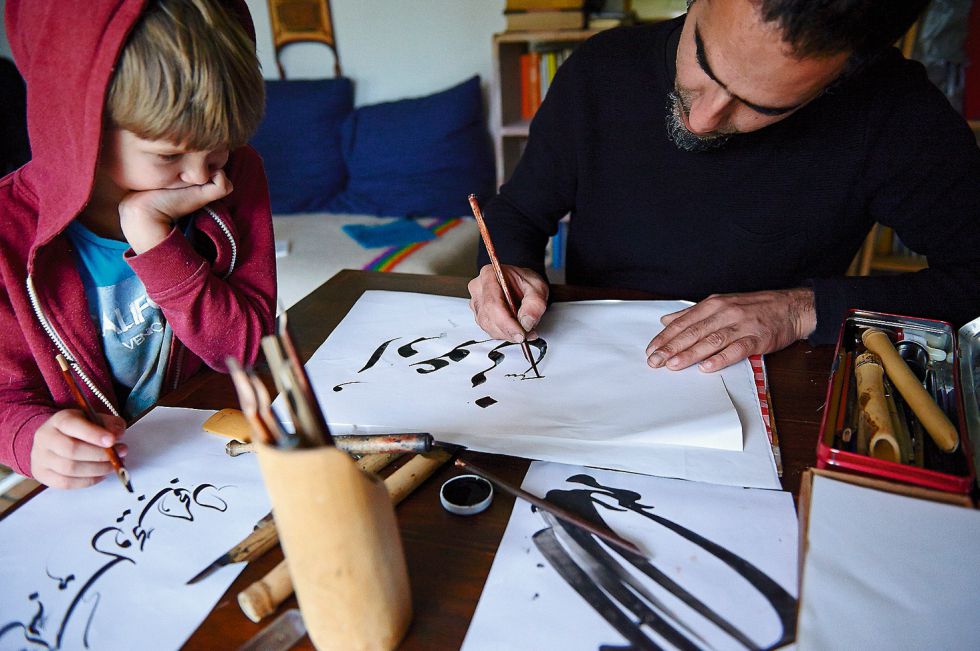
La caligrafía es arte islámico por excelencia. En la imagen, Alí escribe con el cálamo bajo la mirada atenta de su hijo. / FERNANDO SÁNCHEZ ALONSO

Marhaban (bienvenido) es la palabra inscrita en un cartel de madera sujeto a un poste, entre campos de tabaco, huertas y las pocas casas que conforman la Aldea Tudal, una pedanía de Villanueva de la Vera (Cáceres) donde está la segunda comunidad sufí naqshbandí más importante de España, liderada por el sheij y escultor de renombre nacional Abdul Wahid (Cristóbal Martín).

El coche se hunde en la dirección que señala la flecha del cartel. Al cabo de cinco minutos, el camino muere a los pies de la casa de Omar Ibrahim, un madrileño que vivió 35 en Alemania, donde mantuvo durante 10 una cadena de restaurantes. “Luego vendí todo y me vine aquí”.

Es jueves. Omar Ibrahim está esperando a que llegue el resto de hermanos a su casa, que también hace las veces de dergha, para celebrar el dhikr. “Me hice musulmán hace casi 30 años. Y entonces comencé a sentirme verdaderamente cristiano. No hay contradicción, porque Jesucristo es un profeta muy querido en el islam. Creemos en los santos; veneramos sus tumbas y sus reliquias. Esto es algo que nos distingue del resto de los musulmanes”.

A continuación explica el porqué de los patronímicos en el sufismo. “El nombre árabe te lo elige el maestro. Ese nuevo nombre expresa la esencia de lo que realmente eres y sirve para que el discípulo aspire a lograr aquello que significa. Omar, por ejemplo, significa fuerza o sustento”.

Como en Órgiva, los sufíes de Villanueva de la Vera son españoles. “De hecho, ahora solo hay un hermano marroquí”, explica Yamaluddin (Juan Andrés Molina), un madrileño de 44 años. Todo él es una viva estampa de la más pura estética naqshbandi: el anillo en recuerdo del que llevaba Mahoma, la barba solemne, el chaleco y los pantalones amplios de origen otomano que facilitan los movimientos en la oración, el bastón y el turbante verde, que es la corona mística y la mortaja que cubrirá el cuerpo desnudo del sufí.

Las mujeres usan también ropas holgadas y el hiyab o velo para cubrirse la cabeza, algo que a Hawa (Ana Rosa Soto), una zaragozana de 41 años y madre de nueve hijos, le agrada. “La mujer debe vestir con recato. Pero también nos tapamos para proteger dos lugares muy energéticos de nuestro cuerpo: la cabeza y la garganta. Yo, con el islam, he recuperado mi feminidad”, sostiene. “Y nunca se ha metido nadie conmigo por vestir así”.

A Mariam Sakina Scott, nacida musulmana en Órgiva hace 22 años e hija de un norteamericano y una catalana convertidos al islam, el velo sí le ha atraído problemas en su centro de estudios. “Allí todos saben que soy musulmana, pero no hago ostentación de ello”, admite. “En nuestra sociedad prevalece la idea de que el islam es una religión de fanáticos. Pero todavía se entiende peor el sufismo. Hay gente que me ha preguntado si pertenezco a una secta. ¿Cómo decirles que el sufismo es respeto y amor por todas las criaturas?”

El sufismo, que en Europa se conoce, sobre todo, gracias a la danza de los derviches giróvagos de Turquía, “remite a la pregunta de quién es uno en realidad”, dice el sheij Umar Margarit. “Y eso solo se puede responder buscando a Alá en el corazón. Para ello, el sufí cumple con todos los preceptos islámicos, pero no se queda en ellos; los trasciende”.

Los sufíes son víctimas de los movimientos más radicales del islam, desde los salafistas en Egipto o Libia hasta los talibanes en Pakistán, que los consideran heterodoxos. Pero el sufismo es muy antiguo. Hay estudiosos que arguyen que hubo un sufismo preislámico, y lo sitúan en el Gran Jorasán, en el noreste de Irán. Lo cierto es que todavía hoy perduran las controversias eruditas sobre sus orígenes.

Una de las teorías más divulgadas sostiene que el sufismo recibe influjos del monacato cristiano, de la filosofía neoplatónica, del chamanismo de Asia Central, del hinduismo y del budismo. De hecho, el sufí confiesa que su doctrina espiritual, aun insertándose dentro del islam, es la misma que las de las demás religiones: la unión con Dios. Y el único ve­hículo para ello es el amor incondicional a todo y a todos. Ibn al Arabi, el gran místico sufí nacido en Murcia en el siglo XII, lo expresa así: “Mi corazón puede adoptar todas las formas. / Es pasto para las gacelas. / Y monasterio para monjes cristianos, / y templo para ídolos, / y la Kaaba del peregrino, / y las tablas de la Torah, / y el libro del Corán. / Porque yo sigo la religión del amor”.
Los sufíes son víctimas de los movimientos más radicales del islam, desde los salafistas en Egipto o Libia hasta los talibanes en Pakistán, que los consideran heterodoxos. Pero el sufismo es muy antiguo. Hay estudiosos que arguyen que hubo un sufismo preislámico, y lo sitúan en el Gran Jorasán, en el noreste de Irán. Lo cierto es que todavía hoy perduran las controversias eruditas sobre sus orígenes. Una de las teorías más divulgadas sostiene que el sufismo recibe influjos del monacato cristiano, de la filosofía neoplatónica, del chamanismo de Asia Central, del hinduismo y del budismo.

De hecho, el sufí confiesa que su doctrina espiritual, aun insertándose dentro del islam, es la misma que las de las demás religiones: la unión con Dios. Y el único ve­hículo para ello es el amor incondicional a todo y a todos. Ibn al Arabi, el gran místico sufí nacido en Murcia en el siglo XII, lo expresa así: “Mi corazón puede adoptar todas las formas. / Es pasto para las gacelas. / Y monasterio para monjes cristianos, / y templo para ídolos, / y la Kaaba del peregrino, / y las tablas de la Torah, / y el libro del Corán. / Porque yo sigo la religión del amor”.